

I'm on Bulk Message — where's my inbox?
I'm on Bulk Message — where's my inbox?
Bulk Message doesn’t include the shared 2-way inbox — it’s built for one-way broadcast sending. Upgrade to Pro or Agency to get it. Once you’re on Pro or Agency, the inbox lives in the left-side menu.
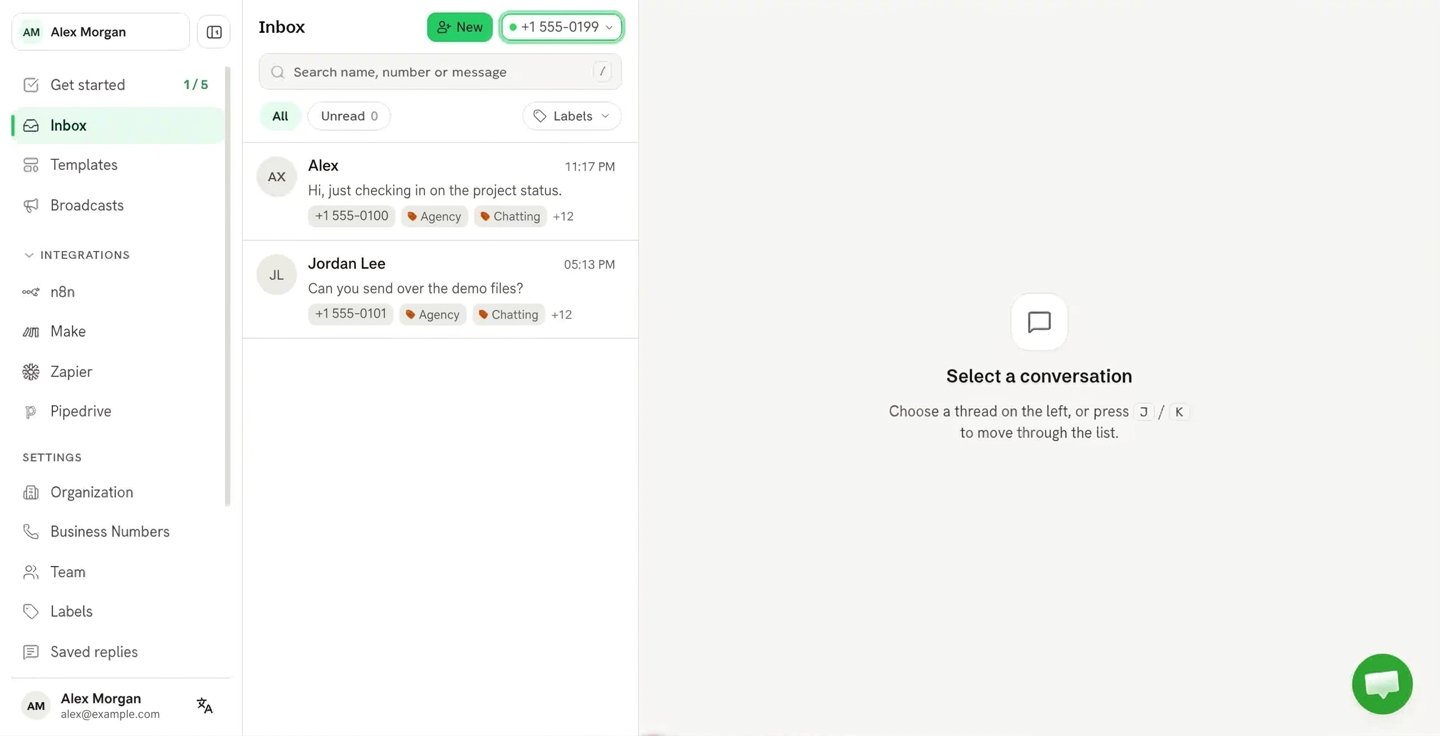
On Pro and Agency, Inbox lives in the left-side menu — open it to see your conversation list
First open: what you’ll see
The inbox is not pre-loaded with demo content. After you connect a WhatsApp number:- It shows only real conversations — no sample chats to click through.
- It’s empty until a real customer messages you (or an import finishes — see below).
Who sees what: access layers
Visibility in the inbox stacks in three layers, plain and simple:1
Phone number
Which connected WhatsApp number (or numbers, on Agency) this person can work at all.
2
Role: Admin vs. chat-only
Admin can manage the account (billing, integrations, templates, other teammates). A chat-only teammate works conversations in the inbox without full account admin.
3
Label-scoped visibility
Within a number, a chat-only teammate can be further limited to only the conversations carrying certain labels — for example, only “Sales” or only “Support” chats.
Underneath, these map to real team roles:
Admin, Team Member (All Labels), and Team Member (label-scoped). See team & roles for the API/Agent Skills view of the same roles.Mobile push notifications follow the same access rule: a teammate is notified only for chats they can access (their number + role + label scope) — not every chat on the account.
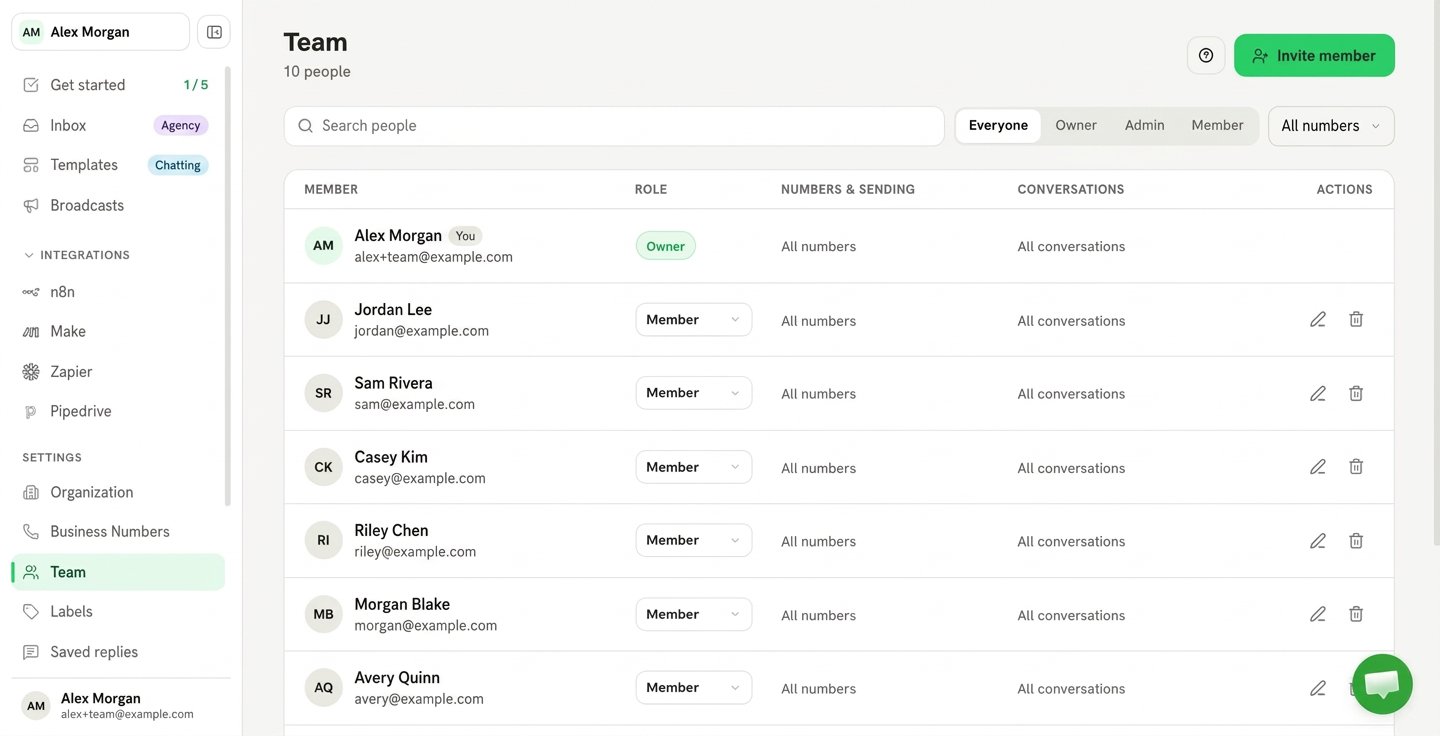
Team settings — role, which numbers someone can send from, and which conversations they can see
Collaborating inside a conversation
Open a conversation and a few things are always available to your team:- Reassigning a chat, in practice, means changing its labels. There isn’t a separate “assign” button today — the way ownership and routing actually happens in the inbox is by adding or removing a label on the conversation (for example, swapping “Unassigned” for a teammate’s name label, or a routing label your automations watch for).
- Let the agent reply. In the contact panel, this toggle controls whether the AI agent sends automatic replies on that chat. When it’s off — for example because a person replied — the bot stops immediately. Turn it on again to hand the conversation back to the agent. See AI Chatbots for bot assignment and other handoff settings.
- A reply typed in the WhatsApp Business app also stops the bot — it’s treated as human, the same as turning off Let the agent reply. See Coexistence below for exactly what that looks like in the inbox.
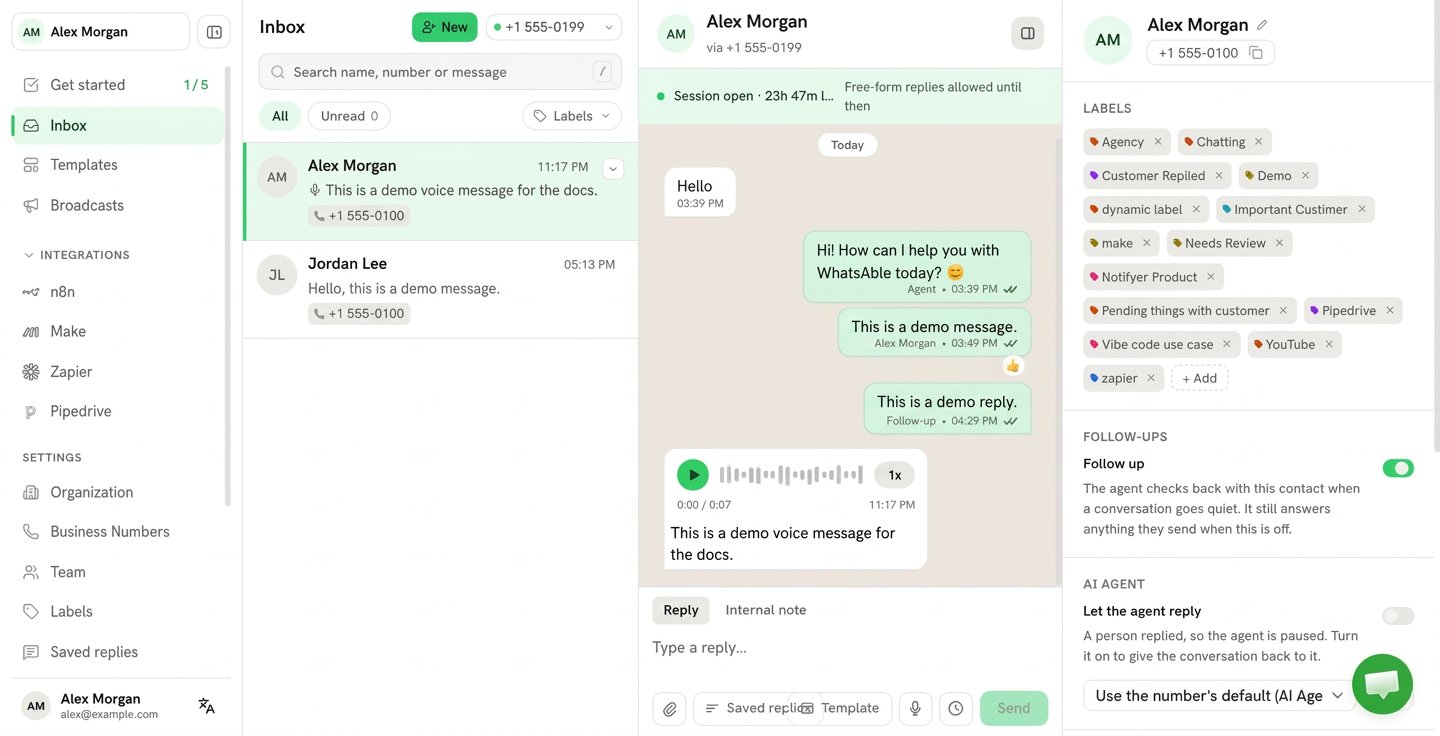
Open conversation — thread, contact labels, and Let the agent reply in the contact panel
Labels vs. notes
These look similar but do different jobs:Labels
Organize and target. Labels group conversations (keyword labels, interest labels, teammate/routing labels) and are also what you aim a broadcast at — see Label Condition in the Zapier scheduling flow.
Notes
Give context, don’t organize. Notes come in two flavors: automation notes (form or Lead Ad field data pushed in via Zapier/Make so the bot has context) and human notes (a teammate’s own written context on the contact).
assign-label.js / add-note.js in the chat-notifyer Agent Skill.
When an automation trigger fires (Zapier, Make, n8n), it carries the current labels and notes along with the conversation paragraph — roughly the last 20 messages of that chat. See the message webhook payload for the exact fields (
labels, note, note_automation, last_messages).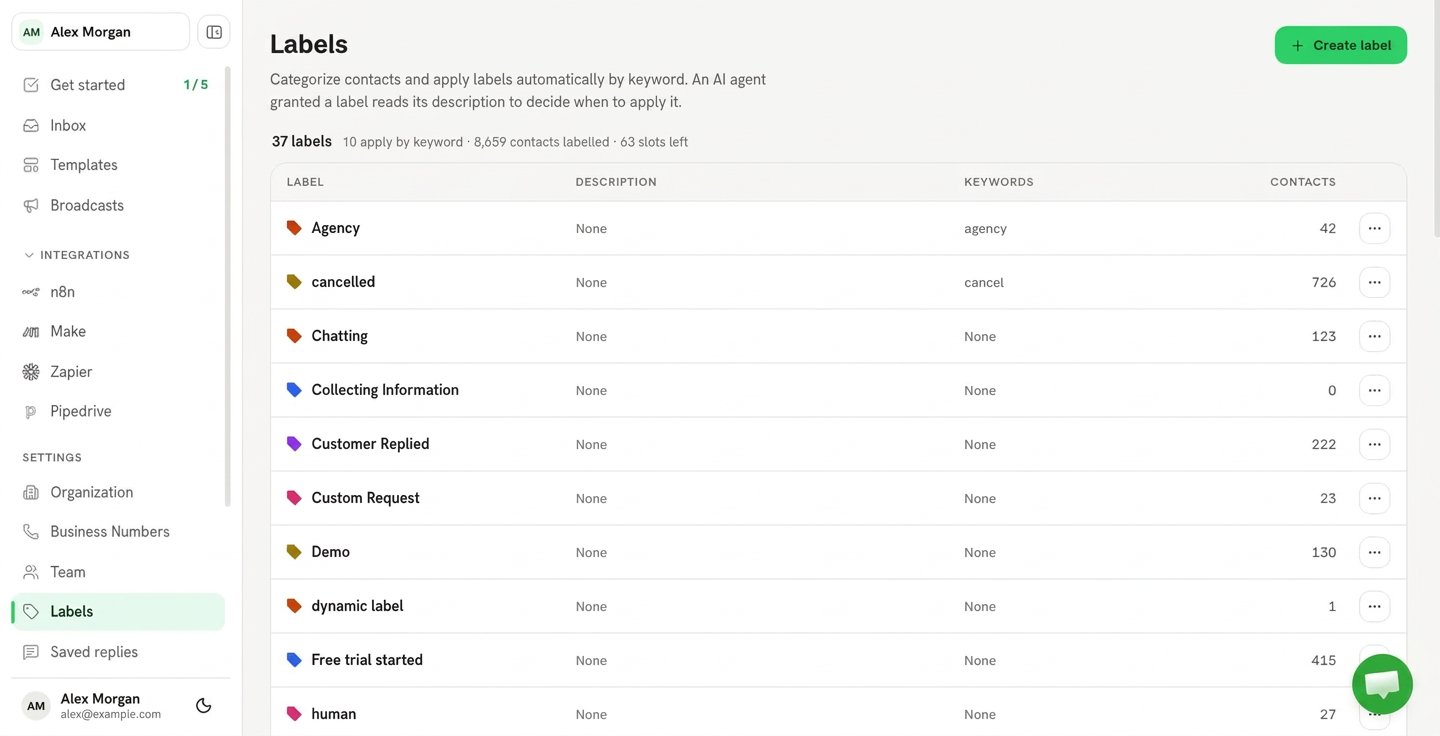
Labels in Settings — categorize contacts, auto-apply by keyword, and use labels for broadcasts and inbox filters
AI ↔ human resume behavior
What happens after a teammate takes over from the bot:1
Turn off Let the agent reply
The bot stops immediately on that chat (a person replied, or you switched it off).
2
History stays
Nothing is lost — the full conversation history stays exactly as it was, bot messages and all.
3
When the agent may reply again
Open Once you reply by hand in Settings and choose when the agent may start replying again after a hand reply — one of the three options in the next section.
Once you reply by hand controls how long the agent stays quiet after you or a teammate reply by hand, before it answers on its own again. In Settings, pick one of:
- The agent stays off until someone turns it back on
- The agent resumes when the customer starts a new conversation
- The agent resumes after a set time
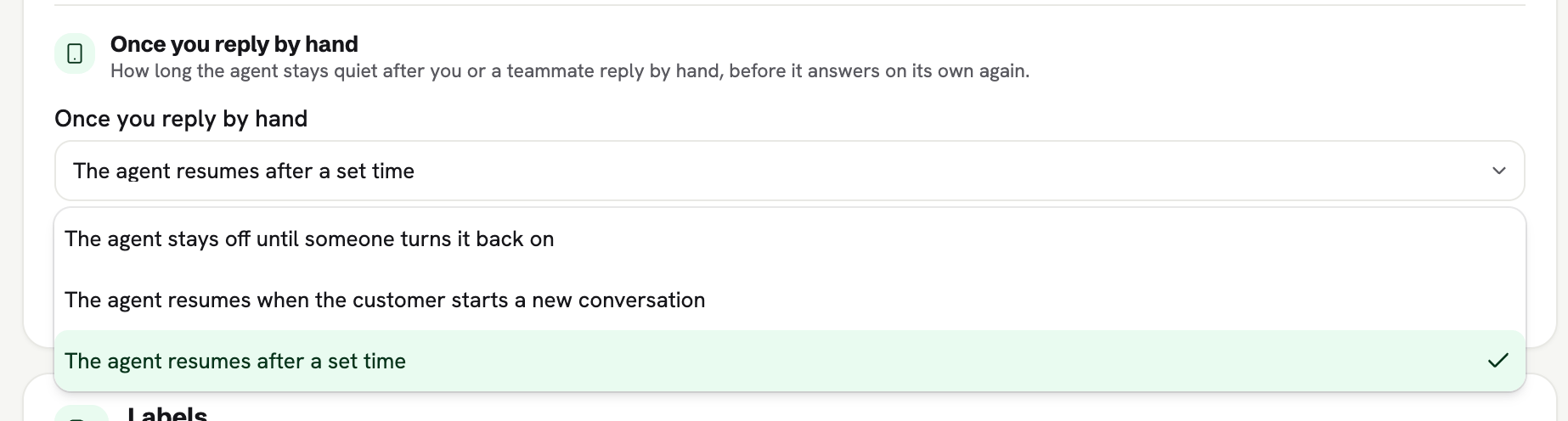
Once you reply by hand — choose when the AI agent may start replying again after a human reply
Coexistence: phone and inbox together
This is the exact, confirmed behavior when your number uses Meta WhatsApp Coexistence and a teammate is in the web inbox while someone replies from the WhatsApp Business app on the same number:- It’s the same customer thread in the web inbox — the sync is real time, not a delayed refresh.
- The reply shows as coming from the WhatsApp Business app, not a named teammate. On the message webhook payload:
send_by: "WhatsApp App",was_message_by_human: true,incoming_message: false. - That phone reply turns off Let the agent reply — the native AI stops auto-replying on that chat, the same as switching the toggle off in the inbox.
- Make, Zapier, and n8n do not auto-pause just because of this. Your scenario keeps running unless you explicitly filter on the human /
"WhatsApp App"signal — see filtering for phone-app replies. - Groups, Status, and Calls do not sync into the web inbox — only 1:1 WhatsApp conversations do.
What this does not do: it doesn’t change chat assignment, it doesn’t guarantee an unread badge fires, and it doesn’t require a hard refresh to see the new message. If you notice any of those, that’s a bug to report, not expected behavior.
Agency: one number or many
If your Agency workspace manages more than one WhatsApp number, you have two ways to work them:- One shared view, filterable by number or by label — your team stays in a single inbox and uses the number dropdown (for example All numbers or one connected line) and the Labels filter on the list to narrow what they see, instead of switching accounts.
- Per-customer logins — if you’d rather keep each client’s number and team fully separate, that’s supported too.
This replaces an earlier draft of this page that said Agency only supported fully separate accounts per number with no shared view. That was outdated — the shared, filterable view above is what’s live. (There’s still no “shared pool of numbers” for billing or usage — filtering a shared view is a UI convenience, not a merged subscription.)
Next steps
Connect a WhatsApp number
Complete Embedded Signup (with Coexistence support) before the inbox has any conversations to show.
AI Chatbots
Bot assignment, handoff keywords, and settings that work with Let the agent reply in the inbox.
Message webhooks
Full payload reference —
send_by, note, note_automation, labels, last_messages.chat-notifyer Agent Skill
Script-level operations for labels, handoff, notes, and conversation history.